


































You see it coming from fifty metres away. An off-leash dog bolting toward you at full speed, owner somewhere in the distance, and then the inevitable shout: "Don't worry, he's friendly!" Here's why that phrase makes every responsible dog owner's blood pressure spike — and what we can all do better.
In Short:
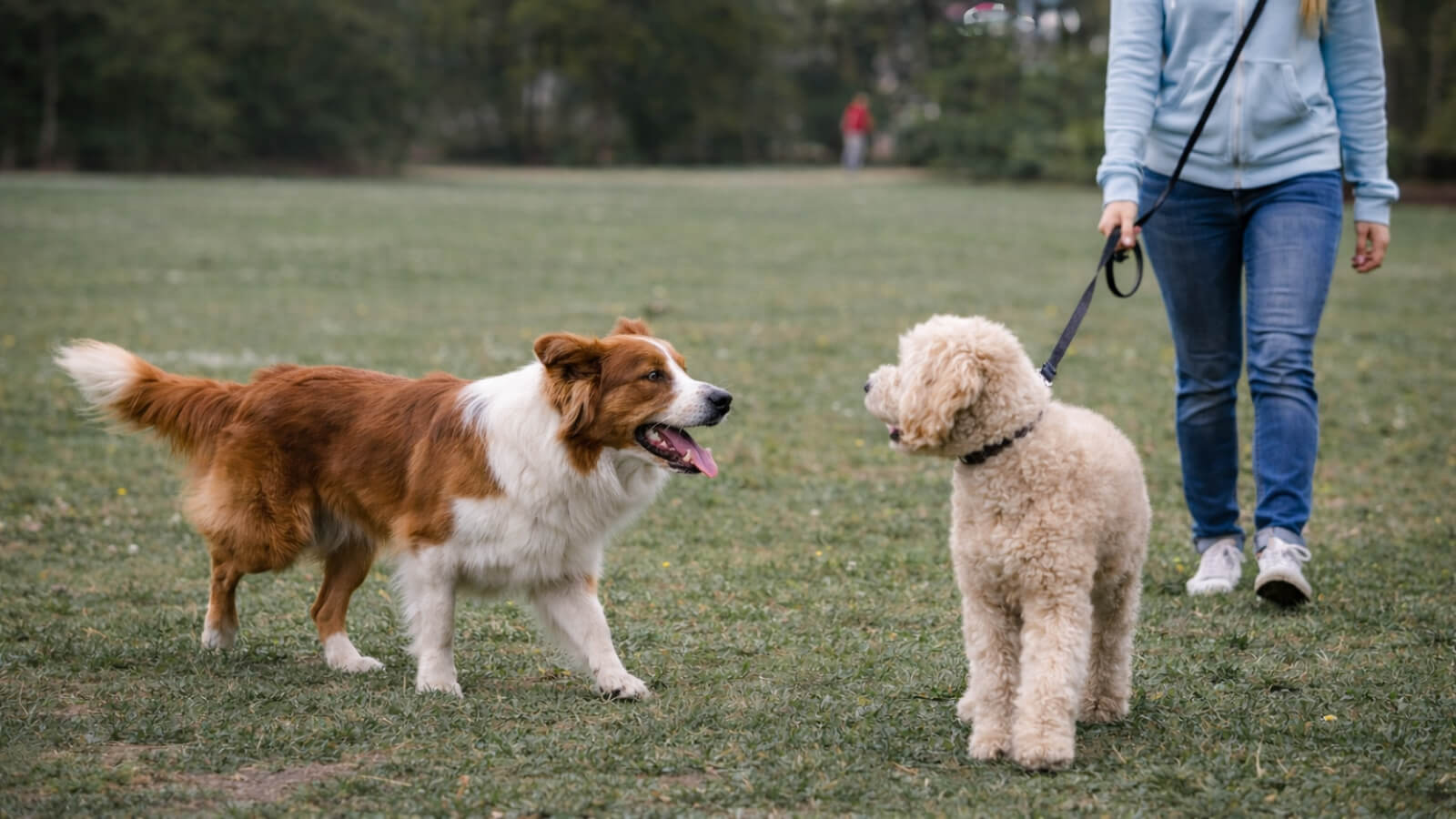
When an off-leash dog charges toward yours and the owner yells "he's friendly!" — it doesn't matter.
Your dog might not be friendly. Your dog might be reactive, recovering from trauma, in training, elderly, or simply not in the mood.
An uncontrolled off-leash dog invading another dog's space can trigger fear, aggression, and setbacks in behavioural progress. It's not about whether your dog is friendly — it's about whether the other dog consented to the interaction.
Why "He's Friendly" Doesn't Matter
Let's get this out of the way: the issue was never whether your dog is friendly. The issue is that you've allowed your dog to rush into another dog's space without permission — and you have no idea what that other dog is dealing with.
The dog on the lead might be:
- Reactive — working through fear or aggression with a trainer, and one bad encounter can undo months of progress.
- Recovering from an attack — dogs that have been bitten or rushed before can develop lasting anxiety around other dogs.
- In pain or post-surgery — a dog recovering from an injury doesn't need a 30-kilo Labrador slamming into them.
- Elderly or frail — older dogs often can't handle boisterous play and may snap out of discomfort or fear.
- A puppy in training — early negative experiences with off-leash dogs can shape a puppy's behaviour for life.
- Simply not social — and that's completely valid. Not every dog wants to meet every other dog.
When someone says "he's friendly," what they're really saying is: "I haven't trained my dog to recall, but I'd like you to be okay with that." And that's not fair on anyone — least of all the other dog.
What Actually Happens When an Off-Leash Dog Rushes a Leashed Dog
There's a well-documented dynamic in dog behaviour called leash frustration or barrier reactivity. When a dog is on a lead and an off-leash dog approaches, the leashed dog can't move freely — they can't retreat, create distance, or use normal body language to manage the interaction. This puts them in a vulnerable position.
The result? A dog that might be perfectly fine off-leash in a controlled setting can become defensive, fearful, or aggressive when approached while restrained. The off-leash dog reads the tension, the interaction escalates, and what started as "just being friendly" turns into a snarling, tangled mess.
Even if nothing dramatic happens, the leashed dog has just learned that other dogs are unpredictable and that their owner can't protect them. Over time, that erodes trust and builds reactivity. One rushed greeting can set a dog's training back weeks.
The Recall Problem
If your dog won't come back to you the moment you call — every single time, in every environment — then your dog doesn't have reliable recall. And without reliable recall, your dog shouldn't be off-leash in public.
This isn't about being strict or joyless. It's about safety. A dog without recall is a dog you can't control in an emergency — whether that's another dog, a child, a cyclist, traffic, or wildlife. "He's friendly" doesn't help if your dog runs onto a road or bowls over a toddler.
Recall is a skill, not a personality trait. It takes consistent training, high-value rewards, and regular practice in progressively distracting environments. If your dog's recall falls apart the moment they see another dog, that's a training gap — not a reason to shrug and let them charge ahead.
It's Also a Legal Issue
In every state and territory in Australia, dogs must be on a lead in public unless you're in a designated off-leash area. If your off-leash dog approaches another dog and causes an incident — even if your dog "didn't do anything" — you may be held liable.
Council rangers can issue on-the-spot fines for dogs off-leash in on-leash areas, and if your dog causes injury to another dog or person, the consequences can include significant fines, vet bill liability, and in serious cases, your dog being declared dangerous.
The law doesn't care whether your dog was friendly. It cares whether your dog was under control.
What to Do If You're the Owner of the "Friendly" Dog
If this article feels like it's calling you out — good. That means you care enough to keep reading. Here's how to be part of the solution:
- Leash your dog in on-leash areas. Full stop. No exceptions. Even if they're "good."
- Work on recall. Invest in proper recall training before letting your dog off-leash anywhere. A long line (5–10 metre training lead) is your best friend while you're building this skill.
- Ask before approaching. If you see another dog owner, call your dog back and ask: "Is your dog okay to say hi?" Respect the answer — including "no."
- Read the other dog's body language. If a leashed dog is stiff, pulling away, hiding behind their owner, or barking — that's not an invitation. Move on.
- Don't take it personally. If someone asks you to keep your dog away, they're not being rude. They're advocating for their dog. That's good ownership.
What to Do If an Off-Leash Dog Rushes You
If you're on the receiving end, here are some strategies:
- Stay calm. Your dog picks up on your tension. Keep your voice steady and your body relaxed as much as possible.
- Create space. Step between your dog and the approaching dog if it's safe to do so. Use your body as a barrier.
- Use a firm voice. A loud, assertive "NO" or "GO HOME" directed at the off-leash dog can sometimes stop them in their tracks.
- Carry a deterrent. A Pet Corrector (compressed air spray) or a handful of treats thrown on the ground can redirect an incoming dog's attention.
- Report repeat offenders. If the same dog is off-leash in an on-leash area regularly, report it to your local council. Rangers can't act on what they don't know about.
Looking for safe, off-leash areas where your dog can run free without the drama? Explore off-leash parks and dog-friendly locations near you on the Dog Directory.
The Bottom Line
Being friendly isn't a free pass. Every dog deserves to walk in public without being rushed by a stranger's off-leash dog — and every dog owner has a responsibility to keep their dog under control, no matter how good-natured they think their dog is.
Train your recall, respect the lead rules, and ask before you let your dog approach. It's not complicated. It's just good dog ownership.
Frequently Asked Questions
Is it illegal to have my dog off-leash in an on-leash area in Australia?
Yes. In all Australian states and territories, dogs must be on a lead in public unless you're in a designated off-leash area. Fines vary by council but can range from $200 to over $500, and penalties increase if your dog is involved in an incident.
What should I do if an off-leash dog attacks my dog?
Prioritise safety — don't put your hands near the dogs' mouths. Try to separate them using a barrier (bag, jacket, water bottle). Once safe, photograph the other dog and owner, get their details, and report the incident to your local council. See a vet immediately, even if injuries seem minor.
How do I train reliable recall for my dog?
Start in a low-distraction environment with high-value treats. Use a long line (5–10 metres) so your dog has freedom while you maintain control. Reward every successful recall generously. Gradually increase distractions over weeks and months. If you're struggling, a qualified positive-reinforcement trainer can help.
My dog is friendly — why can't they say hello to other dogs?
Because the other dog may not be friendly, comfortable, or in a position to handle the interaction. A leashed dog being rushed by an off-leash dog often feels trapped and defensive. Always ask the other owner before allowing your dog to approach, and respect their answer.
How can I find safe off-leash areas for my dog?
Use the Dog Directory to search for off-leash parks, dog-friendly beaches, and exercise areas near you. Each listing includes details on lead rules, hours, and what to expect — so you can find a space that suits your dog's temperament and energy level.






Comments
0 comments
Login to Join the Conversation 💬